
The below is an article I originally wrote in Spanish for Platzi, the largest e-learning platform in Latin America, as part of the promotion for the course I dictate around Sports Marketing. Read the article below in English and here’s the original version in Spanish.
Sport is an essential part of our culture; it builds community, improves health, and increases society’s potential. However, many question the management of the sports industry and its frequent disconnect from humanity’s problems. In large part, those questions are accurate, but today I want to give you my eight predictions for the future of this industry from my perspective, with over ten years of experience, the influence that technology will have on it, and how social values will be the foundation for the business of sport.
1. Fans will influence media consumption (even more)
Just as you now only pay for what you want to see on streaming platforms, including your favorite sport; just as you choose the distribution channel you prefer to showcase your content; you will continue to dictate the course of the media through your consumption. Increasingly, you will see how additional content will predominate over a live match, and you, as a fan, will generate content that will even compete with that of large sports organizations, eclipsing some major media companies. You will increasingly have multiple screens and camera angles to choose from, as if you were the broadcast director; you will decide how you want to watch a sporting event. We are even close to having complete sports broadcasts in a vertical, Stories-like format, and we’ll also be able to purchase merchandise directly from your screen while watching the event.
2. Virtual scenarios will predominate over physical scenarios
Stadiums as such will not disappear, but technology will help ensure that, thanks to Artificial Intelligence, Augmented Reality, and Virtual Reality, you can witness a live sporting event from the stadium while sitting on your couch at home. This isn’t just about putting on goggles but truly experiencing the match as if you were physically there, because stadiums will have virtual spaces where you can even interact with other “virtual” fans. Imagine being in Mexico and being able to attend a live event in London.
3. Athletes will control the industry
The future decisions of the sports industry will not be solely in the hands of executives or businessmen. As athletes have become brands in themselves, you will see how they will dictate the destiny of the industry in the coming years; controlling, for example, how their own and external contracts are drafted thanks to “Big Data.” In 2021, the Belgian Kevin De Bruyne renewed his contract with Manchester City for four more years, valued at $116 million, after commissioning a data science agency to explain both his football performance and brand value to the club. Another example is the players of the U.S. Women’s National Soccer Team, who, after several legal resolutions, are now part of the decisions regarding new sponsorships by the U.S. Soccer Federation.
4. There will FINALLY be diversity in sports
If the FIFA Women’s World Cup has a gender distinction in its name, the men’s tournament, which is simply called the FIFA World Cup, should also have one, right? Women’s football and sport have grown substantially in recent years, proof of which is that the 2019 Women’s World Cup played in France was watched by 1.12 billion people, with 82 million tuning in for the grand final between the U.S. and the Netherlands. Transgender athletes will begin to compete without distinction with greater momentum, as did Jaiyah Saelua, who identifies as fa’afafine according to Samoan culture and was the first non-binary athlete to compete in a men’s World Cup qualifier with the Samoa national team. Likewise, weightlifter Laurel Hubbard became the first transgender athlete to compete in the Olympic Games, at Tokyo 2020 (held in 2021). Diversity in the sports industry will also allow us to see more women and members of the LGBTIQ+ community in executive positions, as is the case with Cindy Parlow Cone, President of the U.S. Soccer Federation, the first woman in the history of that sport to preside over a national federation worldwide.

5. eSports will become conventional
eSports are not the future; they have been the present for many years. There is more audience for the League of Legends world finals than for many international sports tournaments. In fact, I am almost certain that in the next twenty years, they will be included as a sport in the Olympic Games, as the International Olympic Committee is already beginning to evaluate their recognition. It is possible that, due to their popularity, more young people will prefer to compete in professional eSports tournaments than in traditional sports, especially because eSports increasingly require mental and physical skills, which will be reinforced by augmented reality. Similarly, just as influencers are becoming athletes, we will soon see competitions between gamers and professional athletes.
6. Traditional rules will begin to evolve in sports
Just as VAR, or video assistant referee, completely changed the development of a football match, many other sports will seek to evolve their regulations to make the competition fairer or more attractive, due to spectators’ consumption trends. As I mentioned earlier, you will soon see sports broadcasts in a vertical format, which will surely impact the size of the playing field. Likewise, the possibility of shortening playing time in several sports is already being studied due to the short attention span of new generations.
7. Technology will significantly improve athlete performance
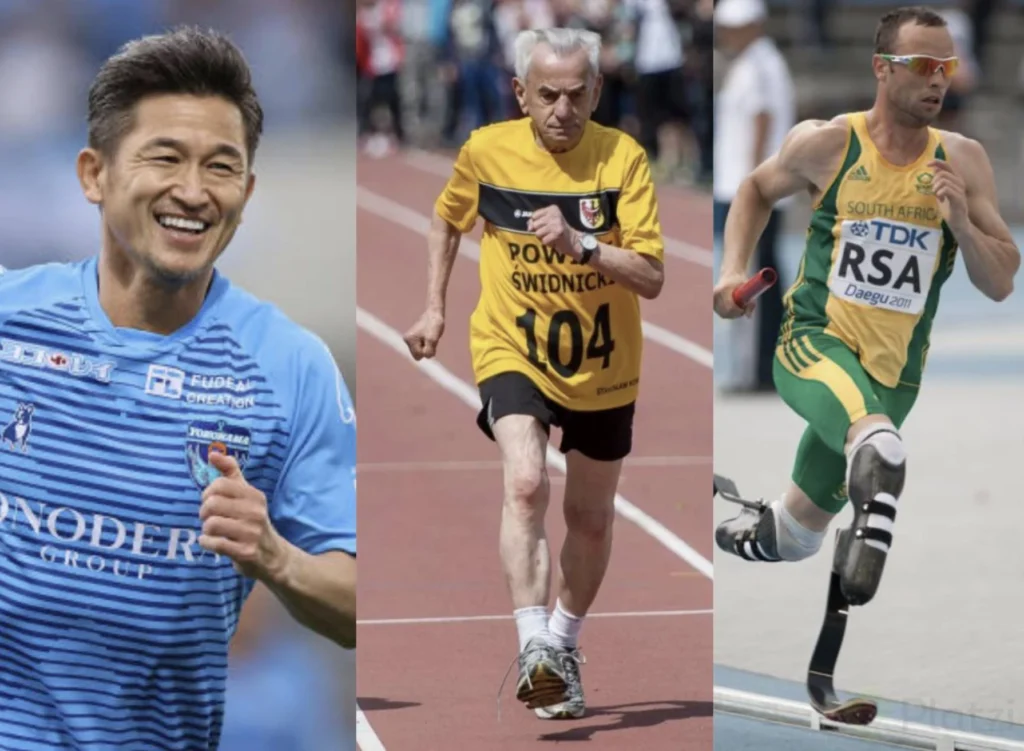
It is no surprise that with greater knowledge comes better technological implementations in training methods to improve athletic performance. Age, for example, will not be a factor; Kazuyoshi Miura is a Japanese footballer who, at 54 years old, continues to play in 2021 with Yokohama FC in his country’s first division, and Stanisław Kowalski, in 2014 at 104, became the oldest person to run in a 100-meter competition. Perhaps more importantly, technologies such as 3D printing, neurofeedback, and genetic strengthening may allow disabled athletes to compete against non-disabled individuals thanks to the regeneration of body parts. So far, more than 10 disabled athletes have competed professionally against non-disabled athletes, with the Australian Oscar Pistorius being one of the most recognized.
8. Betting will permeate the industry, but will be different thanks to us
Thanks to what we call “cyptothings” at Platzi, the betting industry will begin to take an unexpected turn, as we will not necessarily have a company acting as an intermediary. Blockchain and Bitcoin are already part of the sports industry with NFTs, and some organizations accept cryptocurrency payments, but their entry into the betting market is still pending. This will lead to greater transparency in betting transactions and lower costs, allowing you and me to dictate the course of the industry. This will also open a Pandora’s Box, as athletes and sports organizations may want to participate in the betting market, which is currently prohibited due to fears of match-fixing.
We cover all these and many more topics in the Sports Marketing Course, part of the Platzi Marketing School. Let me know what you think of these eight predictions, and I’ll see you in the Course so that you #NeverStopLearning.