Vogue, the Devil Wears Prada, and the Return of Cultural Rituals
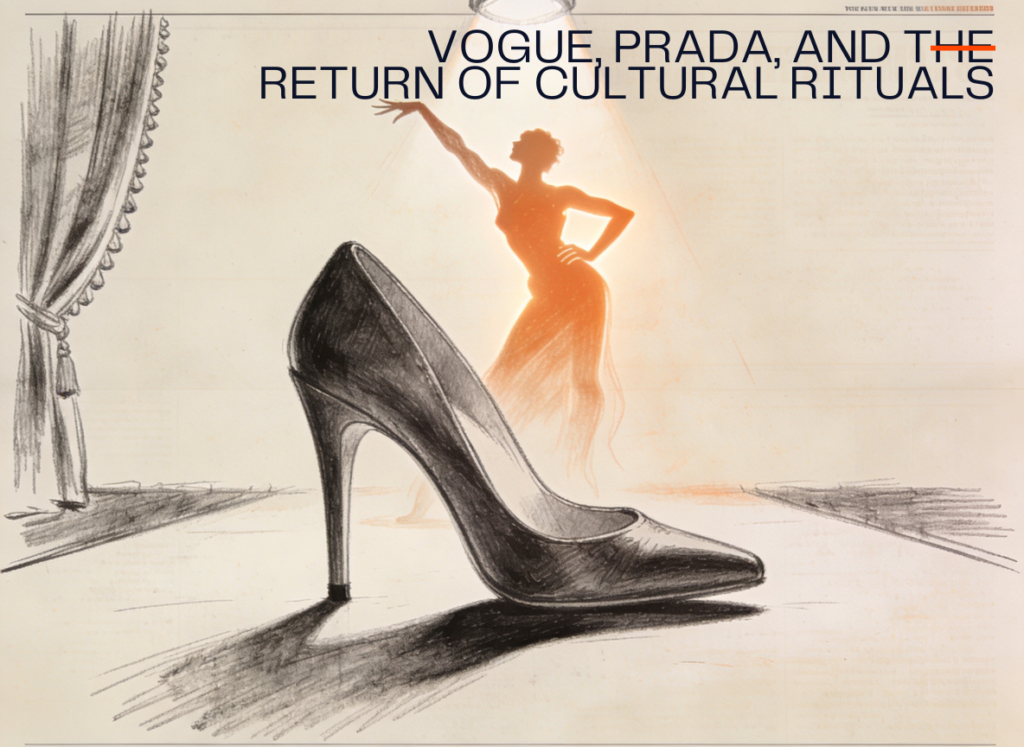
Below is just an excerpt of the entire article. The full article is on HYPHENATED. Click here to read.
There are songs that become hits, and then there are songs that become infrastructure.
Vogue, by Madonna, is infrastructure.
Every few years, the culture rediscovers it as if it had been lying dormant in a drawer somewhere, waiting for fashion, Hollywood, and nostalgia to need it again. That happened in 2006, when The Devil Wears Prada turned it into shorthand for transformation, power, and aspiration. It’s happening again in 2026, as the sequel arrives and the same song instantly becomes part of the conversation all over again. The teaser and trailer were both massive cultural events, and the choice to return to Vogue did not feel arbitrary. It felt inevitable.
That inevitability is the real story.
Because Vogue is not just a pop song that happens to work in a movie about fashion. It is the sound of fashion learning how to think about itself. It is the first time a mainstream pop record gave the world a language for posture, pose, performance, aspiration, and self-invention all at once. And it was born out of something that had lived underground — ballroom culture, queer Black and Latino creativity, the coded elegance of the pose — and made it legible to the rest of the world.
And that matters now more than ever, because the sequel is arriving at a moment when millennials are not just consuming nostalgia, we are organizing our emotional lives around it.
We are the generation that lived through the last great analog-to-digital handoff. We remember magazines (like Vogue and Runway) as objects. We remember waiting for our favorite music videos (like Vogue) to show up on MTV so we could record them on a VHS tape. We remember when fashion meant waiting for September issues, not scrolling through infinite images that all blur into one another. So when The Devil Wears Prada 2 arrives with all its editorial glass, runway hierarchy, and divine cruelty, it doesn’t just feel like a sequel. It feels like a return to a visual and emotional grammar we still know by heart.
In the most recent episode of my podcast, Uncovering the Cover, I dove deeper into the history of Vogue, and how despite not being a cover in its pure sense, became the cover of an entire culture, unknown to most of us. LISTEN TO THE EPISODE HERE.
Why Vogue Still Works
Part of the reason Vogue keeps coming back is that it already understood what culture is now only rediscovering: style is not decoration. It is a form of language.
That is why the song survived the decades. That is why it keeps reappearing in fashion campaigns, drag performances, film scenes, runway edits, and every moment where the culture wants elegance to feel a little dangerous. Vogue did not simply sell Madonna as fashionable. It turned fashion into a cultural verb, because now we’re only fashionable when taste is something we acquire. And once a song does that, it stops belonging to a single era.
But the deeper thing is this: the song’s endurance comes from its source material, which the mainstream never fully credits in proportion to its influence. The ballroom scene was not an aesthetic mood board for pop. It was a survival system. A chosen family structure. A creative response to exclusion, racism, homophobia, and abandonment. Vogue brought that world into the center of pop culture, but the original intelligence — the movement, the pride, the precision, the drama — came from people who were making beauty out of a world that had rejected them.
That is why the song still hits. It carries both the glamour and the grief.
What the Sequel Means Now
The reason The Devil Wears Prada 2 matters is not just that it is a sequel to a beloved millennial classic. It is that it arrives at a moment when the culture is hungry for something that feels edited again.
The internet gave us everything, all at once, in one long uncurated feed. We got volume. We got speed. We got access. But we also lost some sense of (…)